Curriculum
The School follows the curriculum of the Central Board of Secondary Education from Nursery to Class X, and will extend it to Class XI in the 2027–28 session. The programme is organised in four stages, each with its own subjects, its own manner of teaching and its own scheme of assessment. What does not change from one stage to the next is the expectation: that every student is taught thoroughly, known individually, and brought on.
The four stages
Foundation: Nursery to Class II
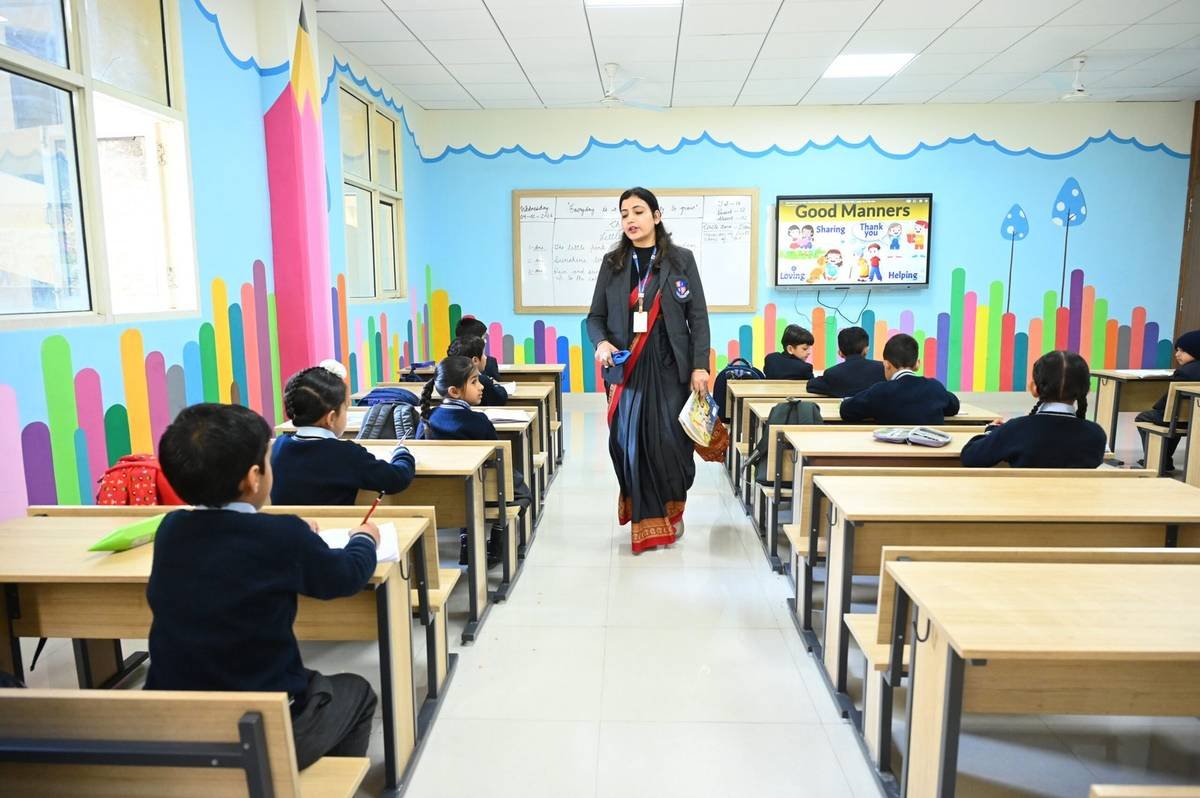
In the first years the work is oral, practical and unhurried. Children learn English and Hindi, the beginnings of number, general awareness, art and craft, and the habits of a classroom: listening, taking turns, finishing a task. Environmental Studies, Information Technology and reasoning are introduced from Class I. Nursery and Kindergarten classes end at one o’clock; from Class I the full day applies.
Primary: Classes III to V
Science and Social Science become subjects in their own right, alongside English, Hindi and Mathematics. Reading with understanding, written expression and numerical reasoning are the priorities of these years. Computer studies, including an introduction to artificial intelligence and robotics, are on the timetable from Class III, and art and craft, general knowledge and moral values continue through Class V.
Middle: Classes VI to VIII
Subjects are taught by specialists from Class VI. Science and Social Science deepen, the latter taking in history, geography, civics and economics. Sanskrit is introduced as the third language and continues to Class VIII, and Artificial Intelligence is offered as a subject across the stage. Students begin regular laboratory work and are expected to study independently, with supervised study periods to support them.
Secondary: Classes IX and X
Classes IX and X follow the Board’s secondary curriculum in five principal subjects, English, Hindi, Mathematics, Science and Social Science, with Artificial Intelligence as an optional sixth. Class IX consolidates the ground covered in the middle school; Class X students sit the Board examination in March, after two pre-board examinations in the School.
Subjects by stage
| Stage | Classes | Subjects |
|---|---|---|
| Foundation | Nursery to II | English, Hindi, Mathematics, General Knowledge, Art and Craft, Moral Values; from Class I, Environmental Studies, Information Technology and Reasoning |
| Primary | III to V | English, Hindi, Mathematics, Science, Social Science, Computer Studies with AI and Robotics, General Knowledge, Art and Craft, Moral Values, Reasoning |
| Middle | VI to VIII | English, Hindi, Mathematics, Science, Social Science, Sanskrit, Artificial Intelligence, Art and Craft |
| Secondary | IX and X | English, Hindi, Mathematics, Science, Social Science; Artificial Intelligence (optional) |
Physical education, music, art and library periods form part of the timetable at every stage, and the morning assembly opens every school day.
The school year
The academic session runs from April to March and is divided into two terms. The first term runs from April to September and closes with the mid-term examination; the second runs from October to March and closes with the annual examination. The School is in session from Monday to Saturday. Classes I to X sit from nine in the morning until four in the afternoon; Nursery, LKG and UKG from nine until one. The academic calendar for the session, with the dates of examinations, holidays and events, is published under Information.
Assessment
Assessment follows the Board’s framework and is spread across the year, so that no single examination carries the whole weight. For Classes I and II there are four formative and two summative assessments in the year. For Classes III to VIII the scheme is as follows.
| Assessment | When | Weight |
|---|---|---|
| Periodic Test I | Third week of June | 10% |
| Mid-term examination | Second week of September | 30% |
| Periodic Test II | Second week of January | 10% |
| Annual examination | First week of March | 50% |
In Class IX the annual examination carries 80 marks and internal assessment 20, made up of written tests, multiple assessments, notebook submission and subject enrichment. In Class X the year is marked by Periodic Test I in June, the mid-term in September and two pre-board examinations in November and December, before the Board examination itself. The qualifying mark in every subject is 33 per cent. Continuous assessment through the year takes account of class participation, homework, quizzes, projects, presentations and portfolios.
Reporting to parents
Progress reports are issued after each assessment and are to be signed and returned. Parent-teacher meetings are held through the year and parents are expected to attend them with their child. Between meetings, parents may follow attendance and marks through the School’s ERP, and may meet the class teacher, the coordinator or the Principal by appointment through the front desk. The School’s view is simple: parents are entitled to know, plainly and in good time, how their child is faring.
Homework, tuition and enrichment
Homework is set to reinforce the day’s work and to build the habit of independent study; it is to be completed on time, and parents are asked to see that it is. Private tuition is discouraged. The School watches each student’s progress closely and, where a child needs more help, arranges enrichment classes within school hours. Once a child is placed in an enrichment class, attendance is required until the child is working at the expected level. Beyond the classroom, students take part in the SOF Olympiads and in Model United Nations conferences, and the School’s teachers attend the training programmes of the Board through the year.